

Neuroscientist from US-Mexico border dismantles science's class problem from the inside
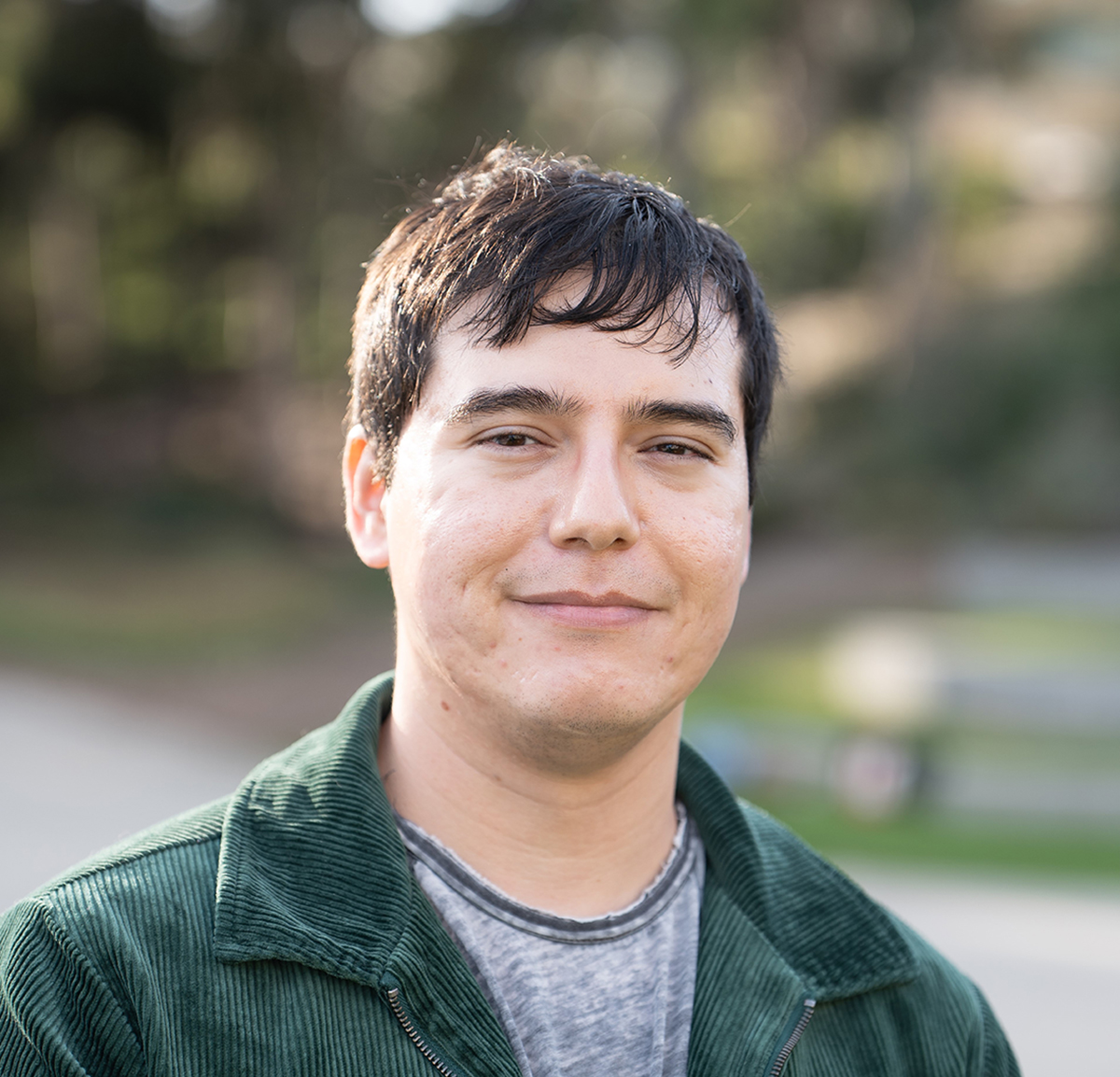
Christian Cazares, PhD, University of California, San Diego, USA.

Colors of the Brain mentors and scholars, 2023.
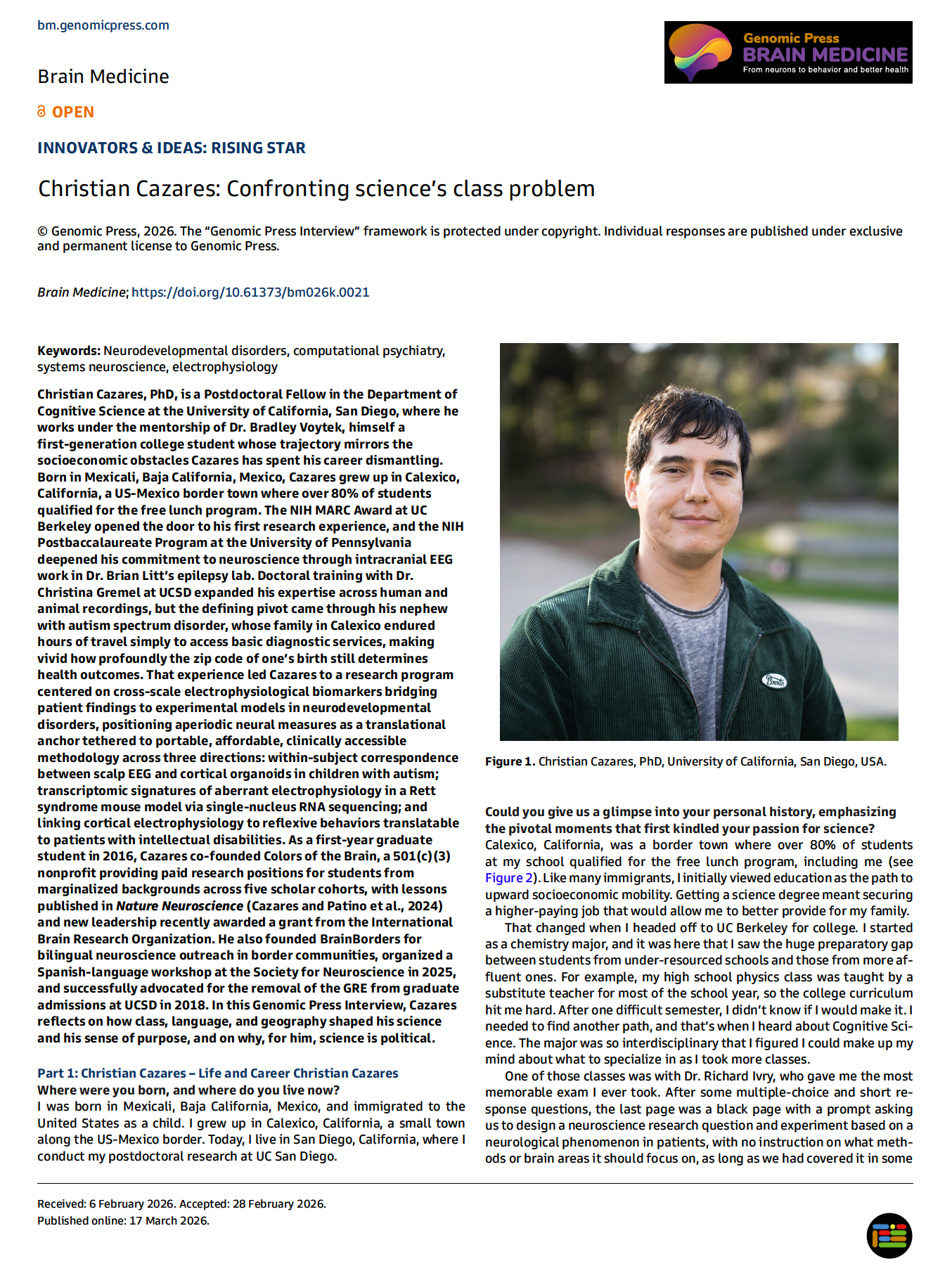
Christian Cazares: Confronting science’s class problem
UCSD postdoctoral fellow funds students, removes GRE barriers, and develops portable EEG biomarkers for underserved communities
The burdens of time, travel, and cost that my family endured just to access basic services made clear to me how much the zip code you are born in determines outcomes.”
LA JOLLA, CA, UNITED STATES, March 17, 2026 /EINPresswire.com/ -- Children with autism and other neurodevelopmental disorders in remote and low-income communities may one day receive accurate diagnoses without traveling hours to reach a specialist. That is the goal driving the research of Dr. Christian Cazares, a postdoctoral fellow in the Department of Cognitive Science at the University of California, San Diego, who is developing portable, affordable electrophysiological biomarkers for conditions including autism spectrum disorder and Rett syndrome. In a new Genomic Press Interview published in Brain Medicine, Dr. Cazares describes three interconnected research programs designed to make scalp EEG, a non-invasive and inexpensive brain recording technique, a reliable diagnostic tool that can function far from major medical centers.— Dr. Christian Cazares, PhD, University of California, San Diego (UCSD)
The significance of Dr. Cazares' research program lies in its convergence of neuroscience and health equity. Working in the laboratory of Dr. Bradley Voytek, whose methods extract physiologically meaningful measures from scalp EEG, Dr. Cazares is pursuing three directions simultaneously. He is establishing a correspondence between patients’ EEG recordings and cortical organoid activity, comparing signals from children with autism with organoids derived from those same patients. He is identifying transcriptomic signatures associated with aberrant electrophysiological signals in a mouse model of Rett syndrome through single-nucleus RNA sequencing. And a third line of inquiry links cortical electrophysiology to innate and reflexive behaviors in patients with intellectual disabilities who cannot complete complex laboratory tasks.
"I envision a future in which a patient's EEG and clinical assessments guide high-throughput screening of personalized therapeutics in brain organoids derived from that patient," he said in the interview. "Most importantly, because EEG is non-invasive, portable, and inexpensive, I hope these biomarkers can someday reach underserved communities far from major medical centers, reducing the disparities that delayed my own nephew's diagnosis."
The defining pivot in Dr. Cazares' research came not from a laboratory result but from a family visit. His nephew, who has autism spectrum disorder and lives in Calexico, California, a town on the US-Mexico border, was hours away from the nearest specialists. The burden of time, travel, and cost that his family endured to access healthcare services transformed an abstract awareness of health disparities into a concrete research agenda. That recognition led him to Dr. Voytek's laboratory, where the choice of EEG as the primary instrument was both scientific and moral: EEG is the instrument; equity is the ambition.
The commitment to dismantling barriers extends beyond the laboratory. Dr. Cazares co-founded Colors of the Brain in 2016 as a first-year graduate student, alongside three colleagues, before he had even passed his qualifying examination. The nonprofit has raised and managed over 230,000 dollars, supported five cohorts of scholars, and produced graduates now enrolled in doctoral programs and leading the organization themselves. The program offers the highest stipends among UCSD summer undergraduate research programs because, as Dr. Cazares argues, unpaid research experiences favor students who can afford to work for free.
Around the same period, Dr. Cazares served as student chair of his graduate program's executive committee and advocated for removing the GRE requirement from graduate admissions at UCSD, presenting research on the test's inability to predict student outcomes and its documented harm to low-income applicants. The committee agreed. The year was 2018, before the broader movement to drop the GRE had gained national momentum. "One financial barrier that I think should continue to be scrutinized is the use of standardized tests like the GRE as gatekeepers to higher education," he said in the interview.
Language, Dr. Cazares argues in the interview, is inseparable from class when science is concerned. Around 80% of journals are published in English, and scientific journalism worldwide relies heavily on English-only sources. He founded BrainBorders to provide bilingual neuroscience education in Calexico and nearby cities. He organized a Spanish-language workshop at the Society for Neuroscience in 2025, and he is preparing a workshop conducted entirely in Spanish on the analytical tools of his postdoctoral laboratory at CETYS, a university in Tijuana, Baja California, Mexico. "I realized I couldn't even present my own research in Spanish, and I started asking myself why," he said.
The conviction that science must serve the communities it studies took root early for Dr. Cazares. He grew up in Calexico, a border town where more than eighty percent of his schoolmates qualified for the free lunch program. A first-generation college student, he once needed research stipends to pay rent. The financial, linguistic, and geographic barriers he faced were not abstractions to be studied later in a career; they were the daily conditions that shaped his trajectory and, ultimately, his research questions.
His philosophy is spare and unambiguous. Asked for the aphorism that best encapsulates his life, Dr. Cazares offered three words: “Science is political.” For Dr. Cazares, that is not a provocation. It is a description of what science has always been and what it can, with effort, become.
Dr. Christian Cazares's Genomic Press interview is part of a larger series, Innovators and Ideas, that highlights the people behind today's most influential scientific breakthroughs. Each interview in the series blends cutting-edge research with personal reflections, offering readers a comprehensive view of the scientists shaping the future. By combining a focus on professional achievements with personal insights, this interview style invites a richer narrative that both engages and educates readers. This format provides an ideal starting point for profiles that explore the scientist's impact on the field, while also touching on broader human themes. More information on the research leaders and rising stars featured in our Innovators and Ideas -- Genomic Press Interview series can be found on our interview website: https://interviews.genomicpress.com/.
The Genomic Press Interview in Brain Medicine titled "Christian Cazares: Confronting science's class problem" is freely available via Open Access, starting on 17 March 2026, in Brain Medicine at the following hyperlink: https://doi.org/10.61373/bm026k.0021.
About Brain Medicine: Brain Medicine (ISSN: 2997-2639, online and 2997-2647, print) is a peer-reviewed medical research journal published by Genomic Press, New York. Brain Medicine is a new home for the cross-disciplinary pathway from innovation in fundamental neuroscience to translational initiatives in brain medicine. The journal's scope includes the underlying science, causes, outcomes, treatments, and societal impact of brain disorders across all clinical disciplines and their interface.
Visit the Genomic Press Virtual Library: https://issues.genomicpress.com/bookcase/gtvov/
Our media website is at: https://media.genomicpress.com/
Our full website is at: https://genomicpress.com/
Ma-Li Wong
Genomic Press
mali.wong@genomicpress.com
Legal Disclaimer:
EIN Presswire provides this news content "as is" without warranty of any kind. We do not accept any responsibility or liability for the accuracy, content, images, videos, licenses, completeness, legality, or reliability of the information contained in this article. If you have any complaints or copyright issues related to this article, kindly contact the author above.
